Other-regarding Decision Making
When people make decisions that affect not only their own welfare but also that of others, those decisions are associated with social and psychological factors. Situational factors (e.g., norms, social distance) interact with individual differences in emotional empathy, motivation, and personality. Within these contexts, people consider whether to help others, whom to help, and how to make moral judgments about others.
Social preferences and well-being
This study examined the distinct relationships of distributive justice preferences and prosocial preferences with empathy, life satisfaction, and subjective socioeconomic status (sSES). The findings suggest that empathic concern is meaningfully related to distributive preferences that prioritize the most disadvantaged individuals, particularly among those with higher subjective socioeconomic status. We interpret this pattern to suggest that empathic concern among higher-status individuals may be associated with distributive preferences that extend beyond the interests of one's own status group. However, endorsing such preferences is accompanied by lower life satisfaction, highlighting a potential tension that may stem from a gap between ideals and reality or reduced social support from one's surroundings.
Poster presentation at the Annual Conference of the Korean Psychological Association (Awarded):
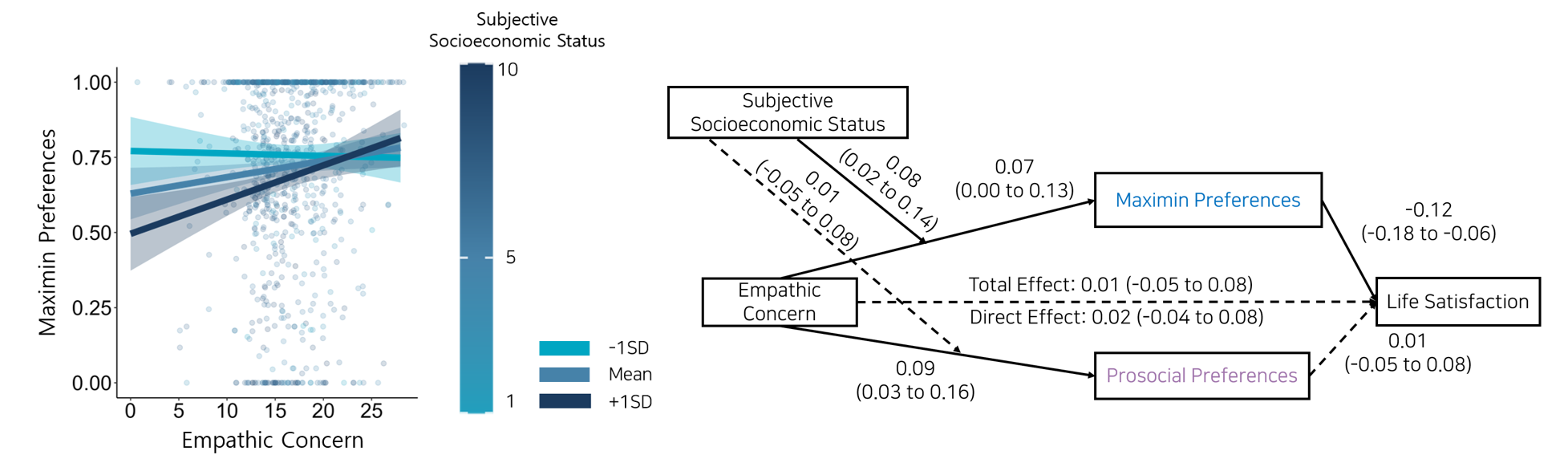
This raises the question of whether lower well-being may discourage subsequent empathy-driven decision making. Further studies on decision making, social learning, or cultural cultivation that incorporate social contexts
would be necessary to address this question.
Lee, T., Kwon, Y., Bang, J., & Sul, S. (2025). The Interaction Effect of Empathy and Subjective Status on the Relationship between Social Preferences and Life Satisfaction. Journal of Social Science, 36(3), 167-188. 10.16881/jss.2025.07.36.3.167
※ This paper is written in Korean. English abstract is here.